

Every few months a story goes around about another regional grocery chain closing, getting bought, or quietly folding into somebody bigger. The Kroger and Albertsons business was the loud version. The quiet version happens constantly, does not make the news, and you find out about it because the store four minutes from your house is suddenly a different store with a different sign.
I have been thinking about that while looking at our own numbers, because Smopper has been tracking Kuhn's Market alongside the two big chains and the results are awkward for me personally.
Kuhn's is not the cheapest store we track. On staples it is not close to the cheapest store we track. And I keep shopping there.
That gap between what the data says and what I do is worth explaining rather than quietly ignoring, so this one is less of a price report and more of an argument.
Start with the number that is not flattering
When I ran the three chains against each other on price per unit, Kuhn's lost to Aldi in every staple category with enough data to call, usually by something in the forty-to-fifty percent range.
And in one category it lost badly enough that I checked the query twice.
SMOPPER INSIGHTS
Kuhn’s Market median price per unit, measured against Aldi
Trimmed median price per canonical unit. Category-wide medians, not like-for-like product swaps.
I am not going to argue the totals away. If your only goal is the smallest possible number at the bottom of a receipt for a list of staples, Aldi wins, it is not close, and I would tell you to shop at Aldi.
On milk specifically I owe you a caveat: a good share of that gap is stocking mix rather than markup. Kuhn's dairy case carries more specialty and local dairy than Aldi's does, and a category-wide median across a deeper premium range lands higher. But it is not all mix. A gallon of ordinary whole milk costs more there and I would be misleading you to pretend otherwise.
The interesting part is what happens when you stop looking at the medians and start looking at the individual lines.
Where a small grocer actually wins
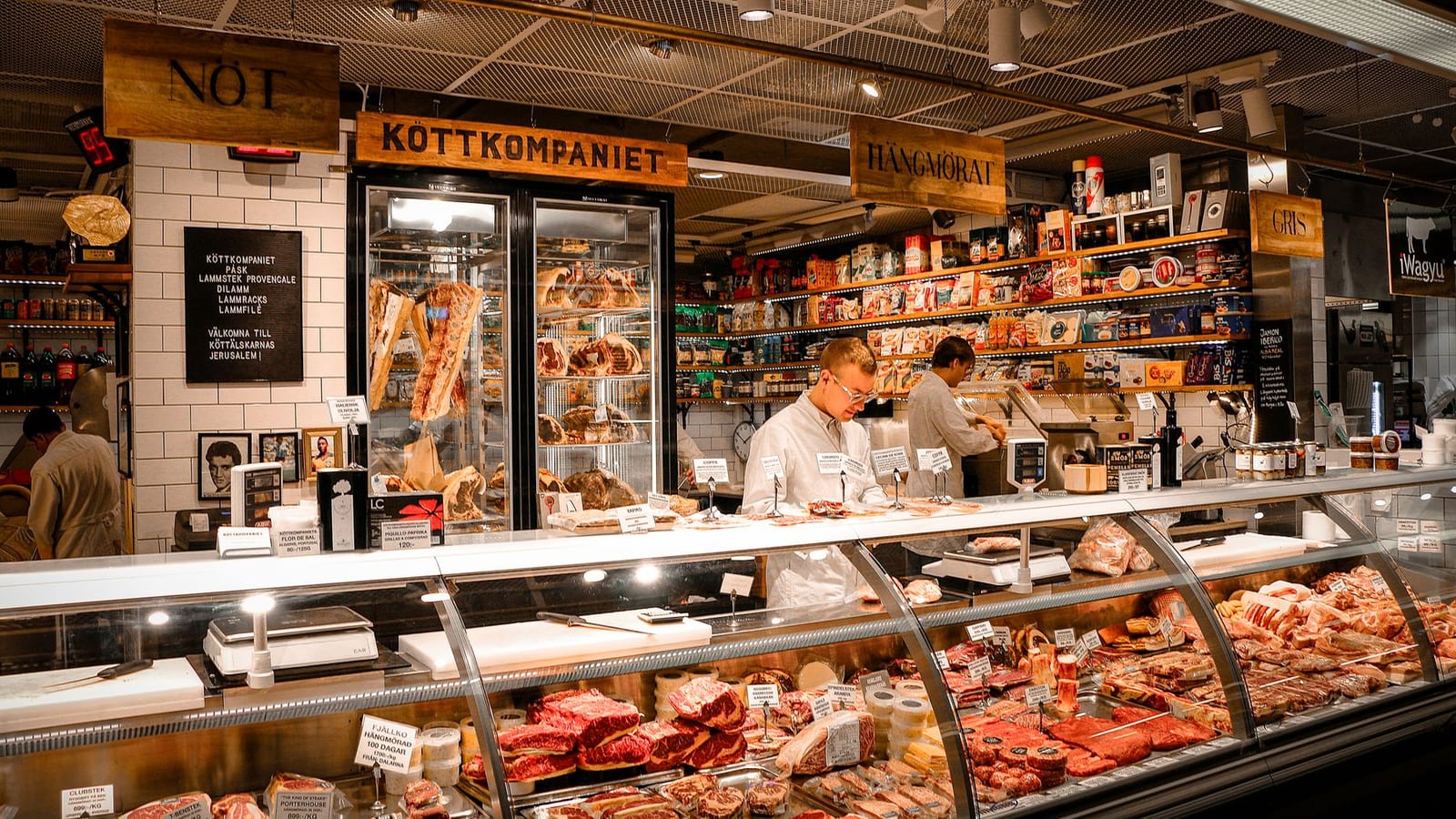
The meat counter is a different product entirely
This is the one that broke our comparison logic, and it took me an embarrassingly long time to understand why.
When Smopper compares ground beef, it compares a packaged tray to a packaged tray. Kuhn's has those. It also has a counter where somebody grinds it, and that product has no UPC, appears in no feed, and fits nowhere in our schema. So for months it was simply absent from our data, and the store looked worse than it is, because the thing a lot of people go there for was invisible to us.
We flag the gap now rather than pretending. Our coverage of Kuhn's shows a hole where counter meat should be, which is unsatisfying and at least honest. Showing a gap rather than a guess is the rule I build by, and this is what it costs when the gap makes a store I like look bad.
Dried pasta, of all things
The spaghetti result at the bottom of that chart is real and it is not a fluke. Kuhn's is the cheapest of the three on dried pasta, and Aldi, the discounter that wins everything else, is the most expensive.
Dried pasta is the classic loss leader. It keeps forever, it is nearly indistinguishable between brands, and a conventional grocer will run it at or below cost to get you through the door. A discounter working on a flat everyday-price model has no answer to that, because it does not do loss leaders at all.
Which is the general shape of it. A conventional grocer beats a discounter on whatever it has decided to promote this week, and loses on everything else.
Produce turns over differently
A small chain with eight locations buys less and buys closer. In practice that means the produce section is smaller and moves faster. I get less choice and fewer sad limes.
On price it is roughly a wash against Aldi most weeks. On the items where I actually notice quality, tomatoes and herbs and anything leafy, I have had a better run there. That is a subjective claim and I am labelling it as one.
The gaps between the products are smaller
Something I only noticed from staring at the raw rows: the spread between the cheapest and most expensive version of a thing at Kuhn's tends to be narrower than at the big chains. There is less of a bottom tier.
That cuts both ways. It means you cannot go there to find the absolute cheapest anything. It also means it is very hard to accidentally buy the worst version of something, which for a certain kind of tired weeknight shopper is worth actual money.
Where it loses, plainly
Pantry staples. Canned goods, dried pasta aside, rice, flour, sugar, anything in a box that sits on a shelf for a year. Aldi's private-label pricing on that whole category is somewhere a small chain cannot follow, because the gap is a function of scale and there is no clever local answer to it.
Household goods, same story, more so. Paper products, cleaning supplies, foil, bags.
Milk, per the chart above.
And the selection is smaller, which is a real cost if you cook across a lot of cuisines. I have driven to a second store for gochujang more than once and I will do it again.
The part that is not about price at all
I run a site whose entire premise is that you should know what things cost, so I want to be careful how I say this.
A store is not only its prices. A store is also a fifteen-minute round trip instead of a thirty-five-minute one. It is whether the parking lot is survivable at five o'clock. It is whether the person behind the counter will cut you a half pound when the package is a full one, and whether there is a person behind the counter at all. Those things have real value, they do not show up in a per-unit number, and a comparison tool that pretends otherwise is lying by omission.
What I would push back on is the version of this argument that gets used to avoid ever looking at the numbers. "It's not all about price" is true, and it is also the most common way people talk themselves out of noticing that they are spending fifteen percent more than they need to. Both things can be true at once. Know the number, then decide what it is worth to you.
For me, on a full week's shop, it is worth something and it is not worth forty percent on staples. Which is why I do not do a full week's shop there.
What I actually do
Aldi for the base of the week: the staples, the pantry, the household goods, all the categories where the gap is largest and the products are most interchangeable.
Kuhn's for meat, for produce, and for the things where I have opinions.
Giant Eagle when the meat flyer is genuinely good, which is often enough to be worth checking and not often enough to be a default.
That is three stores, which sounds exhausting and is really about one extra stop a week. It is a split I only feel good about because I know roughly what each leg of it costs me. The tool is there if you want to work out your own version, which will almost certainly look nothing like mine.
The uncomfortable bit
If Kuhn's disappeared tomorrow I would save money and I would be worse off.
I do not think that is a contradiction, and I do not think it is sentimentality either. The Aldi four miles from me prices the way it does partly because there is a Kuhn's four miles from that. Competitive pressure is not an abstraction; it is the specific reason the cheap store near you is as cheap as it is. Every regional chain that folds into a bigger one takes some of that pressure out of the system, and the effect does not show up as a headline. It shows up as a shelf tag that is forty cents higher than it would otherwise have been, three years later, in a store you still think of as the cheap one.
So the forty percent is not really the price of shopping at Kuhn's. It is closer to the price of there still being a Kuhn's. That is a sentimental way to put it and I have not found a way to say it that is both accurate and unsentimental, so it will have to do.